Your paradise – Your forest garden
HOW TO EASILY CREATE YOUR OWN
FOOD FOREST
© Fauna Funga Flora Designed by M Lewis - Fauna Funga Flora Agency | 2026
Each module covers a wide range of topics and tasks. Study at your own pace.
You have access to the material for a full 12 months after registering!
We explore the history of the forest garden, the definition of a forest garden, and the definition of the method we use in our work.

The step-by-step implementation method, plus a methodology for evaluating and developing your design year after year.

We study forest gardens in Sweden and around the world, their climate value, and the yields a forest garden can generate.

We go through all the layers, from the canopy layer—the highest in the garden—down to the lowest ground-cover layer. We explore companion planting and how to approach combining trees and shrubs.

The value of the forest garden, your personal goal in creating one, and the vision—including scenarios where the site is shared and maintained by multiple people. We also delve into the forest garden's key functions and how they generate optimal value.
We are exploring over 30 different nurseries where we can source perennial plants for every layer of our forest garden—everything from common varieties like apples, pears, and cherries to mulberries, sweet rowans, pawpaws, hardy kiwis, and many, many more.

In this module, we examine growing zones, site conditions, site data, biodiversity, sectors, and garden zones. Your site—from the overall pattern down to the details!

Finally, we go through the resources and how we can make use of them. Some resources take up more storage space than others, some are easier to store than others, and so on. What resources do you have at your location?
We explore the history of the forest garden, the definition of a forest garden, and the definition of the method we use in our work.

We study forest gardens in Sweden and around the world, their climate value, and the yields a forest garden can generate.

The value of the forest garden, your personal goal in creating one, and the vision—including scenarios where the site is shared and maintained by multiple people. We also delve into the forest garden's key functions and how they generate optimal value.

In this module, we examine growing zones, site conditions, site data, biodiversity, sectors, and garden zones. Your site—from the overall pattern down to the details!

The step-by-step implementation method, plus a methodology for evaluating and developing your design year after year.

We go through all the layers, from the canopy layer—the highest in the garden—down to the lowest ground-cover layer. We explore companion planting and how to approach combining trees and shrubs.
We are exploring over 30 different nurseries where we can source perennial plants for every layer of our forest garden—everything from common varieties like apples, pears, and cherries to mulberries, sweet rowans, pawpaws, hardy kiwis, and many, many more.

Finally, we go through the resources and how we can make use of them. Some resources take up more storage space than others, some are easier to store than others, and so on. What resources do you have at your location?
We bought Västergården in the autumn and moved in during November 2016.
What a joy - a place entirely our own!
In 2018, we made our first design draft and started creating our fantastic
forest garden, which we named "Mrs Lewis Garden"!

House seen from the North

Looking up towards the unmown meadow

Creating our first compost

A meadow - Full of possibilities!

Lower garden 2018

Space for perennial vegetables 2019

Leaf raking 2018.

Hügelkulturs are being created!
Without knowing HOW, there are far too many who don't really dare.
I want you to have the confidence in yourself and your capacity to succeed.
When we started our work creating the forest garden,
we had previously made a solid design with a number of key features.
Just like what you will learn in this course!
Our focus became that the forest garden should have a High yield of edibles for a Low labor input .
For us, it was important to get started quickly, to see the possibilities, and to kickstart our journey to help and support biological diversity with habitats and food.
2017 - The most important thing of all, the Forest Garden design was created; we laid the foundation for success by thoroughly studying the site's conditions in combination with us, time, labor input, etc. We created according to the step-by-step method and mapped all projects to SMART to effectively implement everything.
Spring 2018 we planted the first trees and bushes in the forest garden.
We focused on currants, aronia, raspberries, apple trees of various kinds, pears, and plums of various kinds.
Late Summer 2018 - Autumn 2020 we worked with the soil in the forest garden, the secret garden, the lower garden, as well as the garden in front of the house, perennial cultivation in open ground, in raised beds, and sensitive forest garden plants in the greenhouse. All in exciting multi-functional systems and cycles that benefit both us, nature, and biodiversity in various ways.
Summer - Autumn 2021 we worked on filling out the design work and the forest garden with varieties and created a lot of exciting companion plantings. We have created a nut grove (several different types of nut trees, hazel, and other exciting nuts), planted trees and bushes for yields of fruits and berries in an exciting mix (mulberries, apricots, peaches, kiwi, pawpaw, peppers, sweet rowan, pear-service tree, and many more) along with herbs,
During the three years we spent creating and implementing systems, I discovered simple strategies for achieving success in less time, while simultaneously fostering the willingness and creativity in others to be part of this opportunity.
I have systematically reviewed the methodology to identify all the elements a robust design must address, and shaped them into a step-by-step guide, enabling anyone interested to easily create a forest garden without overlooking any crucial components.


...an opportunity to create a FOREST GARDEN easily:
Once the design is complete, it is implemented, and at the same time, one gets to reap the rewards of the work.
It is worth adding that both my husband and I have held full-time jobs throughout the entire process—from the creation and implementation of the design to the harvesting of the returns.

Chicken run in shade and shelter

Herb spiral with its own water intake

Sparkling wine with floral and fruit notes

Thornless blackberries in their glory

Herbs in the secret garden

The greenhouses at the edge of the forest

Juniper in the forest garden

Self-propagation of the herb layer

Propulsion station is created

View of the forest garden

Autumn-bearing raspberries

Walnut tree in the nut grove, 2018

Roses for marmalade & rose water

A view of the forest garden

The forest garden in autumn

The perennial vegetable garden is created
Quality of life is creating a meaning with life,
which others become a natural part of.

After many years of studying permaculture design, my husband and I bought a farm to put all the knowledge we gathered into practice through this method. The dream of creating our own forest garden.
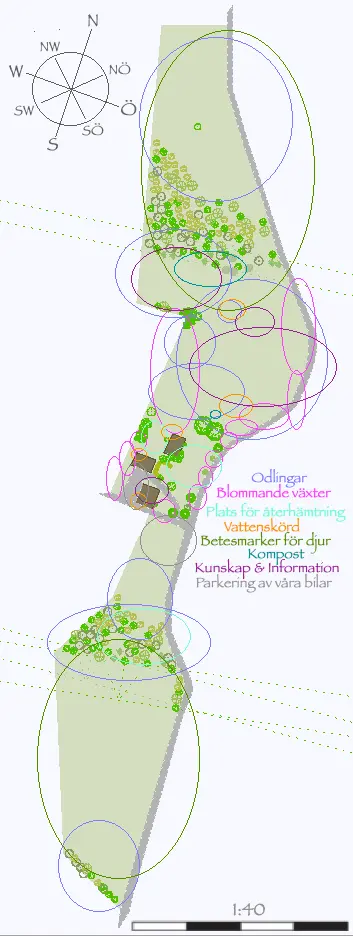
Observed the site over several seasons & thoroughly studied the site's unique conditions and metadata. Having a clear understanding of the site but also knowing exactly what we ourselves wanted from our forest garden was an essential part of creating our own design.
We created the forest garden with the help of SMART goals, maintenance according to Perma-Lean, and evaluated each planting, system, and water cycle to create the ultimate conditions for increasing yields further while lowering labor inputs.
After certain "facts" proved to be variable depending on the environment, and where plantings were revised and recreated, perennial beds were moved and rebuilt to adapt to changes in other areas. Certain systems have been developed to create new and improved results.
If you want to create your own lush, edible forest garden with high yields of fruit and berries tailored to your own desires!
- Remember that you can always reach me by email and phone during the course to ask questions and bounce ideas!
Yes - I want to create my own forest garden design!
If you are not a trained garden designer and feel that this is a disadvantage to getting a forest garden in place...
- The online course guides you all the way from start to finish!
Clients who have created forest gardens – About Mireille Lewis, Certified Permaculture Designer; insights from courses; and how that knowledge helped them turn their garden dreams into reality!
With this course, you quickly create your forest garden design and can start working according to your plan.

Propagating plants for the forest garden planting is part of an initiative to cost-effectively increase the number of plants and, in the long term, the yield from the forest garden.

Basket willows provide shade and absorb large amounts of water.

Hügelkulturs can be found in many places in the forest garden.

Västergården

View towards the forest garden
Do you, just like me, dream of a lush, edible garden that delivers high yields with minimal effort?
Do you also want a low-maintenance space that fosters biodiversity and expands the site’s resources, while promoting a climate-smart mindset for those who live there and enjoy the area?
- Then this course is for you!
The course serves as a knowledge guide, a source of inspiration, and a comprehensive toolkit for anyone wanting to learn how to create a sustainable forest garden. The knowledge gained can be used time and time again!
The methodology and process taught in the course can be applied to any site where you choose to create a forest garden, regardless of where in the country you are located. No prior knowledge is required.
Once your forest garden is complete, the knowledge gained from the course also provides you with the tools to develop it further—allowing you to observe, reflect on, and revise your design until the solutions and systems within it meet your needs and wishes.
You will also receive information on where to find or order plants for your forest garden.
Take care and enjoy!
Home
Courses Online / On Site
Forest Garden Plants
Project
The Forest Garden Blog